
Table of Contents
- Why Socotra Is One of the Best Stargazing Destinations on Earth
- Best Time for Stargazing in Socotra
- What You Can See in Socotra's Night Sky
- Best Places to Stargaze in Socotra
- Where to Camp for the Best Stargazing Experience
- Socotra Stargazing & Astrophotography Tips
- What to Bring for a Stargazing-Focused Trip
- How to Plan a Stargazing Trip to Socotra
- Socotra vs. Other Dark Sky Destinations
- FAQs about Socotra Stargazing
Socotra features a Bortle Class 1 sky, which is the darkest sky. If you're new to Socotra stargazing, we want to help you chase and observe deep sky objects as many as possible! Due to Socotra's equatorial latitude and near-zero light pollution, Socotra Island boasts an extremely clear night sky, making it an ideal place for stargazing. In this guide, we'll explain why you should stargaze in Socotra and how to take enjoyable Socotra tours.
Why Socotra Is One of the Best Stargazing Destinations on Earth
Near-Zero Light Pollution
One of the most prominent advantages of stargazing in Socotra is the unpolluted night sky. When night falls, you can enjoy the darkest skies in the world and the vast universe that is rarely seen elsewhere.
Socotra Island is isolated in the Arabian Sea with a low population density. Apart from Hadibo and the Socotra Airport, the island remains relatively underdeveloped.
We know that city lights are one of the biggest distractions for stargazing. Even though the naked eye can still see many bright stars, the pervasive glow in the city sky will obscure a large number of faint deep sky objects. But there are no nearby metropolitan areas and no industrial light in Sooctra.
Bortle Class 1 – The Darkest Classification Possible
One common metric for assessing whether a location is suitable for stargazing is the Bortle Dark-Sky Scale. This classification was proposed by astronomer John E. Bortle to describe the brightness of the night sky and the extent to which it is affected by light pollution.
It is divided into 9 levels: Class 1 represents the darkest sky, while Class 9 indicates a sky severely affected by urban light pollution. The lower the number, the darker the sky and the better the visibility for stargazing.
Socotra Island features pristine Bortle Class 1 skies with a Sky Quality Meter (SQM) reading of approximately 21.88 magnitudes per square arcsecond. This means that Socotra offers the darkest skies in the world and is one of the best stargazing locations on Earth.
Geography Advantage
Socotra Island, located near the equator, offers prime views of all constellations of the northern hemisphere but also most of the southern sky.
Socotra allows you to see various nebulae and star clusters, such as the Large and Small Magellanic Clouds and the Omega Centauri globular cluster. Socotra Island is one of the best places on Earth to hunt Messier objects throughout the year, like the Andromeda Galaxy (M31) and Orion Nebula (M42).
Except for the brief monsoon season, Socotra Island has mostly clear weather and low cloud cover, making it very suitable for arranging stargazing trips. Low humidity also reduces the scattering of starlight by atmospheric water vapor. As an ocean island far away from the mainland, the dust and water vapor content in the air is low, and the atmospheric transparency is extremely high, allowing starlight to reach the ground almost unobstructed.
The tropical and island weather is still subject to change, so the actual viewing conditions for stargazing depend on the specific season and the weather on that particular night.
Camping Is the Default — Stargazing Is Built In
As a camping-based tourist destination, stargazing in Socotra is not an add-on activity but a default experience. Almost all Socotra tours include a camping experience. Most travelers stargaze while overnight camping on the plateaus, beaches, or mountains. Casual travelers don’t need to book a dedicated astrotourism in Socotra. Camping under the stars in Socotra rewards you with an unforgettable night sky experience.
Best Time for Stargazing in Socotra
Seasonal Overview
Socotra Island has two distinct weather seasons. October to April is the dry season, with clear weather and calm sea surface, making the entire island suitable for sightseeing. From May to September is the rainy season, during which the rainfall is extremely high, and most areas on the island are inaccessible.
Milky Way season generally runs from February to October in the Northern Hemisphere, overlapping with the best time to visit Socotra. From October to April is the peak stargazing season, when the temperature is pleasant, and the skies are clear with few clouds. At this time, the details of the Milky Way and dark nebulae in the night sky can be seen with the naked eye.
Best Months at a Glance
October to November: Although there are still some residual waves of the summer monsoon, the impact is gradually weakening, and the weather is becoming more suitable for outdoor activities. The crowd is very small. At the beginning of the peak tourist season, with clear and cloudless skies, it is an excellent opportunity to observe stars.
December to February: This is the coolest and most comfortable season. The weather is stable at night, and it is unlikely to turn rainy or cloudy. The conditions for outdoor activities at night are usually better. Hiking and camping experiences are very comfortable. The number of tourists visiting Socotra reaches its peak.
March to April: The temperature gradually rises, and the nights become mild and pleasant. These are the perfect months for photography. The endemic flora are in full bloom now. Bottle trees are in bloom with the Milky Way. It is a rare and beautiful sight.
Month-by-Month Stargazing Conditions
From October to April, stargazing conditions will adjust with changes in weather, lunar phases, and seasonal constellations. Different months will present different starry sky experiences. Please refer to the table below to understand the sky clarity, nighttime temperature, cloud cover, and stargazing characteristics for each month.
| Month | Sky Clarity | Temperature (Night) | Cloud Cover | Cloud Cover |
|---|---|---|---|---|
| Oct | Good | Warm (~24°C) | Occasional showers | Post-monsoon, landscape still green |
| Nov | Good | Warm (~23°C) | Some rain possible | Transition month |
| Dec | Excellent | Cool (~20°C) | Minimal | Coolest month, very comfortable for night viewing |
| Jan | Excellent | Cool (~19°C) | Minimal | Peak comfort, clear skies |
| Feb | Excellent | Mild (~21°C) | Very low | Desert Roses begin blooming |
| Mar | Excellent | Mild (~22°C) | Very low | Peak blooming, busiest month |
| Apr | Very Good | Warm (~24°C) | Very low | Seas calm, great for coastal camps |
The New Moon Window — When to Go for Darkest Skies
Please arrange your itinerary according to the lunar cycle planning. It is best to travel during the new moon period, and avoid traveling during the full moon period. The best moon phase for stargazing in Socotra is the new moon.
The moon itself is also a very bright celestial body in the night sky. When the full moon is high, even if there is almost no artificial light pollution in a place, those faint stars, nebulae, and galaxies will still be obscured by its light.
On the contrary, the moonlight effect is minimal around the time of the new moon. If the weather is clear, this is usually the most suitable time to aim for the darkest sky. For astrophotography of the Milky Way, nights near the new moon are particularly popular because the darker sky allows the structure of the Milky Way to stand out more prominently.
If it's just an ordinary traveler and not a professional astronomical photographer, there's no need to follow the phase of the moon strictly. Even if it's not a new moon, a large number of stars can still be seen in low light pollution environments.
What about Meteor Showers?
Socotra sits at a low northern latitude of approximately 12° N, offering an excellent viewing perspective for large meteor showers.
The Geminids are widely considered the most reliable and intense annual shower. The Geminids usually appear around December 13th or 14th each year. On Socotra Island, December also offers clear and perfect camping weather.
The peak of the Quadrantids is usually from January 3rd to 4th. Coincidentally, January in Socotra has clear skies, which you may encounter.
The Perseids, one of the most spectacular meteor showers of the year, is active in August. However, during this period, the summer monsoon on Socotra is at its peak, and as a result, travel to Socotra by tourists is almost completely halted.
When to Avoid
From October to April is almost the only period of time when it is possible to travel to Socotra. It is recommended not to book trips between May and September.
From May to September, it is the southwest monsoon season. The weather is cloudy and rainy, and the sea conditions are very bad, making it unsuitable for stargazing and outdoor activities. The bad weather not only makes it difficult to observe stars, but also affects camping and sea transportation. Moreover, most of the Socotra tour operators will suspend their tourism activities.
If you must travel to Socotra for stargazing during the monsoon season, you can still take the flight from Aden to Socotra. However, the risk of flight cancellations to Socotra has increased. And due to the unstable weather, the stargazing experience might be quite disappointing.
What You Can See in Socotra's Night Sky
Because Socotra has almost no light pollution, its night sky offers one of the clearest windows on galaxies, nebulae, and star clusters on Earth. Many celestial bodies can be observed with the naked eye without the need for a professional telescope. Here are the scenes you can see in the night sky of Socotra.
The Milky Way
The nights on Socotra Island are completely dark with incredibly bright stars. Its low latitude provides an excellent vantage point for observing the bright Milky Way galactic core. You can combine the "glory Milky Way" with unique and distinctive trees such as the umbrella-shaped aloe vera and the swollen bottle tree for your photography.
Southern & Northern Constellations
Due to the extremely close geographical location of Socotra in Yemen to the Earth's equator, you can view both Northern and Southern hemisphere constellations.
The famous "Big Dipper" and "Little Dipper" can be clearly seen. The North Star (Polaris) is located at a low point on the northern horizon, approximately at an altitude of 12°N. Other Northern constellations visible from Socotra include Cassiopeia and Cepheus.
The low-latitude location enables some southern celestial objects to be within the field of view as well, such as Centaurus, Carina, Scorpius, and Sagittarius.
Zodiacal Light and Airglow
With a sufficiently dark sky, you might still be able to observe zodiacal light and airglow with your naked eyes. You can capture airglow through long-exposure photography because it is typically invisible to the naked eye. The zodiacal light is most visible in the western sky after the end of the twilight in the spring, or in the eastern sky before the dawn in the autumn.
Planets and the Moon
In addition to the Milky Way and constellations, the night sky of Socotra also features planets and moons. The silver radiance of the moon shines on the surreal Dragon Blood Forest and white sand dunes, presenting an exotic landscape.
The bright planets such as Venus, Jupiter, and Saturn are usually very easy to identify in the night sky on the appropriate dates and times. Mars and Jupiter can be seen in the eastern sky before sunrise. Saturn and Neptune can be observed on most nights.
Meteor Showers
Due to its geographical location and pristine environmental conditions, the main meteor showers on Socotra Island are exceptionally clear and visible every year. The main annual meteor showers visible from the island include:
The Quadrantids (early January): They can be seen before dawn.
The Eta Aquariids (early May): These meteorites are fragments left by Halley's Comet. Socotra's location is very suitable for capturing these fast meteorites.
The Perseids (mid-August): It is recognized as one of the most spectacular meteor showers of the year. You can find an open area and look towards the northeast.
The Orionids (late October): Formed by fragments of Halley's Comet, this rain stream moves along the celestial equator. Excellent visibility is provided over Socotra Island.
The Leonids (mid-November): Famous for historic "meteor storms".
The Geminids (mid-December): One of the best and most active annual meteor showers.
Best Places to Stargaze in Socotra
In Socotra, you can enjoy the stars, constellations, and the Milky Way. And these beautiful scenes complement the local endemic plants, such as the famous Dragon Blood Tree, desert rose, and white sand dunes.
Diksam Plateau & Firmihin Forest — The Dragon Blood Tree Observatory
Location: Central island, 1–2 hours from Hadibo
Elevation: Around 700 meters (about 2,300 feet)
Why it's exceptional: Ancient Dragon Blood Tree forest, most iconic astro foreground on Earth
Campsite context: Camping among the trees
Best for: Astrophotography (Dragon Blood Tree + Milky Way compositions), general stargazing, first-time visitors
Diksam Plateau is one of the best spots for Socotra night photography with iconic tree silhouette compositions. During the day, you can hike through the Diksam Plateau to explore the unique flora and fauna. After sunset, you can simply wait for the stars to appear near the campsite. The Milky Way galactic core is usually visible in the sky from late evening until just before dawn.
Arher Beach — Stars over Sand Dunes
Location: Northeastern coast of Socotra
Elevation: The dunes are approximately 100 to 200 meters (about 330 to 650 feet) high.
Why it's exceptional: Towering white sand dunes meet the Arabian Sea
Campsite context: Beach or dune-side camping
Best for: Astrophotography, beach camping, Milky Way landscapes
The vast white sand dunes provide a completely unobstructed 360-degree view for stargazing. You can camp directly on the coast or at the bottom of huge 100 to 200-meter sand dunes. Looking up at the starry sky on the towering white sand dunes of Socotra, you will be amazed by the stunning night sky of Socotra Island, which is as beautiful as a photograph. You can enjoy the sunrise at Arher Sand Dunes while watching the stars.
Homhil Plateau — Bottle Trees and the Infinity Pool
Location: Northeastern part of the island
Elevation: 300 to 500 meters (approx. 1,000 to 1,650 feet)
Why it's exceptional: Stargazing combined with the natural infinity pool and endemic flora
Campsite context: Mountain plateau camping
Best for: Astrophotography and naked-eye stargazing against a surreal landscape of endemic plants
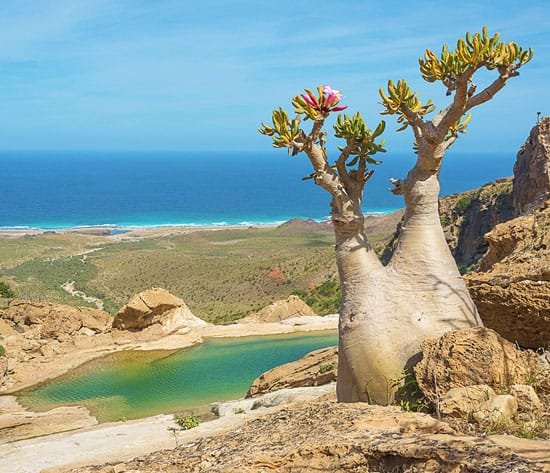
The Homhil Protected Area is an ideal place to combine stargazing with hiking and plant exploration. It boasts the unique bottle trees, frankincense, and dragon's blood trees of Socotra, as well as mountainous terrain. The thick and twisted trunks of the desert roses (bottle trees) contrast with their pink flowers, adding an air of mystery to the scene under the starlight. During the day, you can either hike or drive to the famous natural infinity pool, where you can swim and overlook the Arabian Sea.
Detwah Lagoon & Qalansiyah Coast — Ocean Meets Stars
Location: Northwestern Socotra, near Qalansiyah
Elevation: Near sea level
Why it's exceptional: White sand, turquoise lagoon, and expansive night skies
Campsite context: Camping in basic beach camps near Detwah Lagoon
Best for: Coastal stargazing, Milky Way photography, surreal sunset views
Stargazing in Socotra's Detwah Lagoon offers an incredible, remote astrophotography and dark-sky experience. Detwah Lagoon is one of the most astonishing coastal landscapes on Socotra, with tranquil turquoise waters and a blindingly white sandbar. Due to the fact that the lagoon is located on the northwest coast near Kalansia, without major cities, the night sky is exceptionally clear, making it very suitable for viewing the Milky Way and constellations.
If time permits, you can also combine Detwah Lagoon and Shoab Beach. Shoab usually needs to be reached by boat from Qalansiyah. If you want to explore more of Socotra's beaches, Amoak Beach is another good choice for stargazing.
Wadi Dirhur & Canyon Floors
Location: Central Socotra, near the Diksam Plateau
Elevation: About 500 to 800 meters (1,600 to 2,600 feet) for plateau elevation
Why it's exceptional: Dramatic canyon walls, rocky terrain, and pristine dark sky
Campsite context: Wilderness camping
Best for: Milky Way photography, rugged landscapes, and wilderness experiences
Wadi Dirhur is known for its deep canyons and spectacular rock formations. Overnight at the bottom of the canyon, you will experience a very secretive and pitch-black environment. The core of the Milky Way galaxy spans directly between spectacular vertical limestone cliffs and the contours of unique bottle trees.
High Hajhir Mountain Camps
Location: Northern Socotra
Elevation: Approximately 1,500 meters (5,000 feet)
Why it's exceptional: High-elevation mountain scenery, umbrella-shaped Dragon Blood Tree
Campsite context: Mountain camping
Best for: Multi-day trekking, Indigenous Culture
The Hajhir Mountains are one of the highest and most rugged mountain systems on Socotra. The higher altitude of the Hajhir Mountains allows you to rise above most of the fog and dust in the lower atmosphere, making the clarity of the visible constellations even more pronounced.
Where to Camp for the Best Stargazing Experience
Why Camping Is the Preferred Way to Experience Socotra
Joining Socotra camping tours is the most immersive way to experience Socotra's night sky. It is an unforgettable highlight to sleep under the Socotra dark sky while camping beneath Dragon Blood Trees or on a remote beach.
There are no commercial luxury hotels on the island. Traditional hotels are almost entirely limited to the capital city of Hadibo. Staying in a hotel requires traveling back and forth on rugged and unpaved terrain for several hours every day.
Camping allows you to be close to remote natural wonders on the island. When observing stars at night, there is no need to commute from distant towns, making it easier to take photos during prime time. You can easily enjoy and photograph the Socotra Milky Way.
Camping Options and Facilities
The camping conditions in Socotra are generally basic. Some campsites are jointly operated with the local community, while others are private campsites.
The camping facilities vary greatly depending on the type of campsite you have booked. Due to the remote location of Socotra, all equipment and resources must be transported by travel agencies via 4x4 vehicles. Usually, camping sites and travel agencies provide tents, mats, blankets, toilets, showers, power, Starlink satellite Wi-Fi, and more.
Socotra Stargazing & Astrophotography Tips
Camera Gear Recommendations
For astrophotography on Socotra, pack a full-frame mirrorless camera or DSLR camera, which provides superior low-light performance, high dynamic range, and clean high-ISO performance. And bring a fast wide-angle lens (f/2.8 or wider), a sturdy carbon-fiber tripod, and a portable star tracker.
Shooting Settings for Beginners
Set your camera to Manual Mode (M) with a wide aperture (f/2.8 or lower), a shutter speed of 10 to 15 seconds, and an ISO between 1600 and 3200 to capture sharp, clear stars. Shooting in RAW format gives you more flexibility when adjusting exposure, white balance, and shadows during post-processing.
Best Foreground Compositions Unique to Socotra
Socotra Island offers unique foreground elements like the iconic Dragon Blood Trees or alien-like bottle trees. The Arher Beach Dunes, Detwah Lagoon, the canyons, and the mountain contours can also create a strong composition.
Naked-Eye Stargazing Tips for Non-Photographers
Turn off all flashlights, mobile phone screens, and campfires, and allow your eyes to fully adjust to the darkness within 20 to 30 minutes. Then you will see thousands of stars and the intricate details of the galaxy.
If you need to navigate or find something, use a headlight or flashlight with red light mode. Red light will not damage your night vision.
Plan to stargaze in Socotra during the new moon or when the moon rises late in the night. The bright moon is like natural light pollution, blurring the faint stars.
What to Bring for a Stargazing-Focused Trip
Socotra astrophotography demands unique preparation. Because Socotra Island has limited electric power supply outside the capital and highly rugged terrain on its interior plateaus, your packing checklist must balance specialized astronomy gear with remote camping essentials.
Red light headlamp: Maintaining your night vision is critical. Bring a headlamp with a dedicated, strong red-light mode so you can adjust your camera or telescope settings without ruining your eyes' adaptation to the dark.
Photographic equipment: It is recommended to prepare a camera, a wide-angle fast lens with a large aperture, light pollution filters, spare batteries, a memory card and a power bank.
Sturdy carbon-fiber tripod or star tracker mounts: It is essential to keep long-exposure shots from blurring.
Lens dew heater elements: Coastal areas and high plateaus (like the Diksam Plateau) experience heavy midnight dew and sharp drops in temperature. Lens dew heater elements are critical to prevent condensation from ruining your glass mid-sequence.
Travel binoculars or a lightweight telescope: For scanning the Milky Way. It can also be used as an observation tool for wild animals during the day.
Warm clothing: The nighttime temperature may be low, so it is necessary to prepare warm clothing.
How to Plan a Stargazing Trip to Socotra
Why You Can't Do This Independently
To enjoy a relaxing trip to Socotra, the most important thing is to choose a licensed local Socotra tour operator.
The tourism infrastructure on Socotra Island is limited. To reach remote natural attractions, a 4×4 vehicle, a local driver, and a guide familiar with the route are usually required. Additionally, the entry permits for tourists, flights, and itinerary arrangements usually need to be coordinated by the local operator.
Contact us to plan a Socotra tour with a Socotra stargazing experience.
Do You Need a Special Stargazing Tour?
You do not need a special astrotourism in Socotra to enjoy the night sky. For most tourists, a regular Socotra camping tour itinerary can satisfy the stargazing experience.
The regular Socotra camping tour usually visits places like Diksam, Firmihin, Arher, Homhil, and Detwah, and may involve camping at these locations. These spots are far from large cities and strong artificial light sources, so even after exiting the tent at night, one can enjoy a very good stargazing experience.
If you are a professional stargazer or astrophotographer and need specialized Socotra astrophotography, it is recommended to choose or customize a stargazing-friendly itinerary and communicate the details with the tour agency in advance, including moon phase date, campsites for each night's stay, generator usage and quiet hours, etc.
Getting to Socotra
You can get to Socotra Island by booking a licensed tour operator who will secure your Yemeni visa and reserve your flight on Yemenia Airways from Jeddah, Saudi Arabia.
Taking a direct flight from Jeddah is the best way to visit Socotra. At present, flights to Socotra Island are very rare (usually only two round trips per week) and require booking several months in advance. The flight dates are every Tuesday and Thursday. The Abu Dhabi route will temporarily cease operations from January 2026.
A secondary option is to fly from Cairo with a layover or stopover in mainland Yemen, but this route involves longer travel times and security considerations.
Safety & Responsible Travel
Overall, Socotra Island is safe. However, since it belongs to Yemen, the regional situation may affect flights. Before booking a trip to Socotra, please consult first and purchase travel insurance.
Socotra is home to a large number of unique species and a fragile island ecosystem. Socotra stargazing tours usually set up camp in pristine highlands like the Diksam Plateau or along coastal dunes like Arher Beach. Pack out all garbage and leave no trace.
Try to minimize the use of artificial light in the camp. Use low-intensity red lamps during astrophotography sessions to protect nocturnal wildlife and preserve your natural night vision.
Socotra vs. Other Dark Sky Destinations
Socotra Island is located in the northwest of the Arabian Sea, far from mainland cities and large population centers. The unique natural landscape is composed of deserts, mountains, coasts, and dragon blood tree forests. The number of tourists is relatively small, and the artificial light pollution at night is also low. The stargazing experience here cannot be replicated elsewhere.
| Feature | Socotra | Atacama (Chile) | Jasper (Canada) | Aoraki Mackenzie (NZ) | AlUla (Saudi Arabia) |
|---|---|---|---|---|---|
| Bortle Class | 1–2 | 1–2 | 2–3 | 1–2 | 2–3 |
| Hemisphere access | Both | Southern only | Northern only | Southern only | Northern only |
| Milky Way core visible | Yes (brilliant) | Yes (brilliant) | No | Yes | Limited |
| Unique foregrounds | Dragon Blood Trees, Desert Roses | Volcanic landscapes, salt flats | Mountains, lakes | Mountains, lakes | Desert canyons |
| Accessibility | Difficult (charter flights) | Moderate | Easy | Easy | Moderate |
| Crowd levels | Very low | Moderate (observatory areas) | Moderate (seasonal) | Low–moderate | Rising |
| UNESCO World Heritage | Yes | Partially | Yes | Yes | Yes |
| Cost | Mid-range tours | Wide range | Budget–luxury | Budget–luxury | Mid–high |
FAQs about Socotra Stargazing
1. Is Socotra good for stargazing?
Yes. Socotra, being far from large cities and industrial zones, has a low population density and limited overall development, resulting in very minimal artificial light pollution. Additionally, the dry season is relatively suitable for outdoor activities, allowing for exceptionally rich starry skies on clear nights. This is particularly true in camping areas like Diksam, Firmihin, and Arher, which are far from inhabited settlements.
2. Can I see the Milky Way from Socotra?
Sure. The low light pollution environment of Socotra is very suitable for observing the Milky Way. Especially on clear nights with weak moonlight, it becomes even more obvious. Tourists don't need professional equipment; with the naked eye, they can see the Milky Way.
3. Is it safe to stargaze at night in Socotra?
Yes, it is very safe to stargaze in Socotra. Stargazing at night should be conducted within the safe boundaries arranged by local guides and travel groups. Do not leave the camp alone in search of a darker sky.
4. Do I need a guide for stargazing?
The trip to Socotra usually requires organization by a travel agency and is accompanied by a local guide and transportation. The local guide of Wild Socotra Tours knows the best viewing spots and can assist tourists in choosing the appropriate stargazing location based on the weather, terrain, and environment.
5. What is the best month for astrophotography on Socotra?
October to April generally offers a favorable Socotra astrophotography window. For darker skies, plan your trip around the new moon and check the weather forecast.
6. Can I stargaze without camping?
Yes. Hotels are available in Hadibo. But camping in remote areas offers a more immersive Socotra night photography experience, with less artificial light and immediate access to spectacular natural foregrounds.
7. Do I need special equipment for stargazing in Socotra?
No, you do not need special equipment to stargaze in Socotra. You can see a brilliant night sky, including the Milky Way and constellations, with just your naked eyes. Astrophotography requires specialized, reliable, and portable gear, like cameras, telescopes, mounts, lenses, and accessories.
8. Can I see the Magellanic Clouds in Socotra?
Yes, you can see the Magellanic Clouds from Socotra because the island lies close to the equator at roughly 12° N latitude.
9. How does Socotra compare to Atacama for stargazing?
The Atacama Desert offers excellent and scientifically optimized conditions for professional astronomy and high-altitude observations, while Socotra Island boasts an extremely dark, unpolluted, and visually surreal tropical setting, renowned for its dramatic astrophotography.
10. Are there any light pollution concerns on Socotra?
Socotra has exceptionally low light pollution and is widely regarded as one of the best stargazing locations on Earth. Especially, the remote campsites boast particularly dark and largely unpolluted night skies.
Plan Your Socotra Stargazing Tour with Wild Socotra Tours
Socotra offers you a profound and awe-inspiring experience, as if you were on an alien planet. If you long for an adventure that goes beyond ordinary stargazing and combines the vastness of the universe with strange creatures, then Socotra Island is undoubtedly the unique answer.
Try searching for and identifying these nebulae and star clusters in UNESCO-listed Socotra. Professional Wild Socotra Tours offer you epic Socotra stargazing adventure tours.

Have a Question?
You might see your comment appear on this page, but your email address and full name will not be published. Your personal information will remain confidential. Our Asia travel experts will get back to you as soon as possible. Required fields are marked *